
From the Sensex pack, Adani Ports & Special Economic Zones, Mahindra & Mahindra, Reliance Industries, HDFC Bank, Larsen & Toubro, NTPC, State Bank of India, UltraTech Cement and Kotak Mahindra Bank were the major gainers. In contrast, Tata Steel, Titan, Bajaj Finserv, JSW Steel, Bajaj Finance, Hindustan Unilever, ITC, Tata Motors and Tata Consultancy Services were among the laggards.

From the outcome of the general elections and then Union Budget to tepid corporate earnings in the September 2024 quarter (Q2-FY25), sticky inflation and Reserve Bank of India's stance on interest rates, extreme weather conditions, Indian stock markets have braved it all in calendar year 2024.

The RBI Governor, however, added it was 'difficult to say when that will take place and in what shape it will roll out'.

The Reserve Bank on Thursday said that the overall stance of its monetary policy for this fiscal would continue to accord a high-priority to price and financial markets stability and well-anchored inflation expectations.

Between March 2010 and October 2011, RBI had 13 rate hike.
The time frame for this is difficult to specify and much depends on stability in the foreign exchange markets, Prime Minister's key economic advisor C Rangarajan said.

'If gold's recent surge has increased its allocation beyond 15 per cent in your portfolio, now may be a good time to rebalance.'

The RBI kept its key policy repo rate unchanged at 8.0 percent in its recent monetary policy.
Second-best performer after Brazil so far this year.
The Reserve Bank of India in its quarterly monetary policy review has hiked rates.

Economists and experts have suggested that the central bank should intervene in the Indian forex market to halt the sharp depreciation in rupee value.
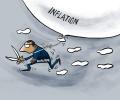
Most members of the Reserve Bank of India's monetary policy committee (MPC) decided to stick to the course on bringing retail inflation to the target of 4 per cent while voting for maintaining status quo in the April review, except external member Jayanth Varma who voted for a 25 bps cut in the repo rate. "I believe that the extant monetary policy setting is well positioned," RBI governor Shaktikanta Das said in the minutes of the policy review, which came out on Friday. "Monetary policy transmission is continuing and inflation expectations of households are also getting further anchored.

The Reserve Bank of India kept interest rates on hold at 7.50 per cent.

India Inc on Friday said it is looking forward to a repo rate cut in future as cost of funds has to come down in coming times, and expects continuation of accommodative policy stance by the Reserve Bank of India (RBI). The RBI decided to leave the benchmark interest rate unchanged at 4 per cent but maintained an accommodative stance, as the economy faces the brunt of the second COVID-19 wave. Sanjay Aggarwal, president of PHD Chamber of Commerce and Industry, said the RBI has maintained an accommodative stance as long as necessary to revive and sustain growth on a durable basis and to mitigate impact of COVID-19, apart from an aim to keep inflation within the target.

Food inflation, which was 11.40 per cent for the week ended July 31, is in double digits for the second consecutive week, after it remained in single digit for a fortnight in mid-July.

Here are the highlights of the monetary policy announced by RBI governor Shaktikanta Das on Friday.

Foreign portfolio investors' (FPIs') net investments in the domestic debt market surged in December, marking a 77-month high, that is, since July 2017. According to market participants, this significant uptick in FPI inflows can be attributed to the post-domestic policy outcome and the US Federal Reserve's dovish stance at the December policy. FPI inflows into debt stood at Rs 18,393 crore in December against Rs 14,106 crore in November, according to data on the National Securities Depository Limited.

'Investors can consider staying invested in long duration products as there is a possibility of rate cuts in the near term.' Positive macros - lower inflation, high forex reserves and favourable demand-supply dynamics for government bonds - make a strong case for rate cuts from December, says Devang Shah, head of fixed income, Axis Mutual Fund. In an interview with Abhishek Kumar in Mumbai, Shah says this view may not hold true if commodity prices go up sharply.

Data released on Thursday showed prices of essential commodities like cereals went up by 12.7 per cent, rice by 11.75 per cent, wheat 12.6 per cent and pulses rose by 42 per cent.

It may be a 'no-go' for banking licences to large industrial houses.
Abheek Barua explains how the central bank's acceptance of a new normal for inflation could drive future policy decisions.

Both the indices closed at five-month highs, led by financial services, IT and metal stocks, amid persistent foreign fund inflows.

The Reserve Bank of India on Friday decided to keep benchmark interest rate unchanged at 4 per cent but maintained an accommodative stance even as the economy is showing signs of recovery after the second Covid wave.

User protection and a proposal for a licensing framework for companies seeking to operate in the cryptocurrency area will be part of an upcoming consultation paper on the sector, said a senior industry executive. Even as specific regulations around crypto are yet to take shape, companies are setting up baseline user protection processes, including a redressal mechanism, fraud detection, regular filing of suspicious transaction reports (STRs), among others.

The RBI said there is an upward bias on inflation projection.

RBI Governor Shaktikanta Das kept the red flag on cryptocurrencies flying, warning that the next financial crisis can be triggered by private cryptocurrencies if such speculative instruments are allowed to grow.
RBI is likely to keep interest rates stable in the near term, revealed Moody's. It may also ease its monetary policy stance later in the year.
Battling a sharp surge in inflation, the Reserve Bank is all for a smooth monetary policy response and the desire to have smaller hikes led it to tighten the policy in an off-schedule meet, a source said on Thursday. Inflation has been massively impacted by Russia's invasion of Ukraine and will in due course also reflect the dent caused by Indonesia banning palm oil exports, the source aware of central bank thinking said, indicating that there was no other option but to respond. "The idea is to have a smooth policy response, not to put in large cold turkey responses," the source said, making it clear that the preference is for smaller magnitude responses and not larger ones.

When he didn't respond (Mr Saver has lost count of how many relationship managers he has had in the past few years!), the gentleman landed up at his doorstep and started pleading with him to open fixed deposits with the bank, observes Tamal Bandyopadhyay.

Industry body Assocham said the focus continues to be on rising inflation and not on the country's economic growth.

Assocham expressed concern over the precarious situation that the manufacturing sector is in, observing that if the trend does not reverse with monetary and fiscal measures it would be difficult for the industry to generate jobs.

The cutback on export credit refinance facility is another step towards a shift away from sector-specific liquidity allocations.

Referring to the proposed new monetary policy framework, it said in the weeks ahead, government and RBI will work towards it.
The RBI assessment would come amid euphoria generated by the news that the GDP grew 8.4 per cent during the second quarter ended September 2003.

The Reserve Bank of India on Thursday kept the benchmark interest rate unchanged at 4 per cent and decided to continue with its accommodative stance against the backdrop of an elevated level of inflation.

IT and interest rate-sensitive bank, realty, and auto stocks ended with sharp gains.
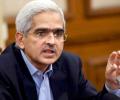
Reserve Bank of India (RBI) Governor Shaktikanta Das had stumped the market in the previous two policies - in August and in October - first with action and then with words. In August, it was the introduction of an incremental cash reserve ratio (I-CRR) to take out excess liquidity, which took the markets by surprise. In October, there was no action. Rather, what is known as "open mouth operation", Das' comment that the central bank might conduct open market operations (OMOs) by selling bonds tempered the euphoria in the bond markets after JP Morgan's inclusion of India in its Emerging Market Bond Index.
It further pointed out that the twin balance sheet problem -- at the end of banks and corporate -- more attractive interest rates for borrowers in the bond market and from non-banking financial institutions are other reasons for slow bank credit growth.
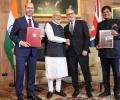
'That way you're not hostage just to US sort of exports to India.'

Retail inflation inched up to 4.48 per cent in October due to an uptick in food prices, government data showed on Friday. The Consumer Price Index (CPI) based inflation was at 4.35 per cent in September and 7.61 per cent in October 2020.
